Showing posts with label social studies. Show all posts

Sunday, June 29, 2014

Learning About the Taíno Peoples, and Christopher Columbus

*PLEASE BE AWARE that the Taino people did not wear clothing, and though they are usually shown clothed in books and videos, some artwork online or in documentaries may depict them in various stages of nudity.  I encourage parents and teachers to choose resources ahead of time and preview all documentaries or books, even those recommended here, to make sure you find them appropriate for your children.

In addition to studying the life and voyages of Christopher Columbus, we decided to devote equal time to learning about the indigenous peoples he first encountered.  I wanted Hunter to understand that while Columbus is a celebrated historical figure who certainly changed the world, these changes resulted in tragedy for the inhabitants of the lands he "discovered".


We read many books about Christopher Columbus in addition to our main history text, but these are the two we found the most helpful.  Click on either of the pictures to check them out!


Here's the Interactive 3D Map of Columbus' first voyage that Hunter colored and assembled.  Looks great, doesn't it?  He worked so hard.


Some of the pieces are glued down, but the ships move along the track between Spain and the Caribbean.


We got the map from this book, and look forward to making more!  Click on the picture to find out more about the book; it's a great addition to any homeschool.


He also completed this fabulous flip-flap book from Simply Skilled in Second.  (The finished product can include one of Columbus' ships!  Follow the link to see her examples.)


Each flap has maps, writing prompts, questions, or space to draw so the student can really show what they've learned.


We use these flip-flap books a lot, for history, science, and language arts.  She has a fantastic collection and it's growing all the time!


Hunter loves documentaries, and we were happy to find this one by National Geographic on YouTube.  The title is a little misleading; it's really about the impact of European settlement on the North and Central American civilizations.  It's a good jumping off point for discussion about the positive and negative aspects of the Columbian exchange, and whether any of the negatives could have been avoided. 


This story by Jane Yolen is told from the point of view of a young Taíno boy who is suspicious of the strangers that have suddenly appeared in his land.  He tries to warn the adults of his village that the newcomers seem more interested in gold than friendship, but no one listens.
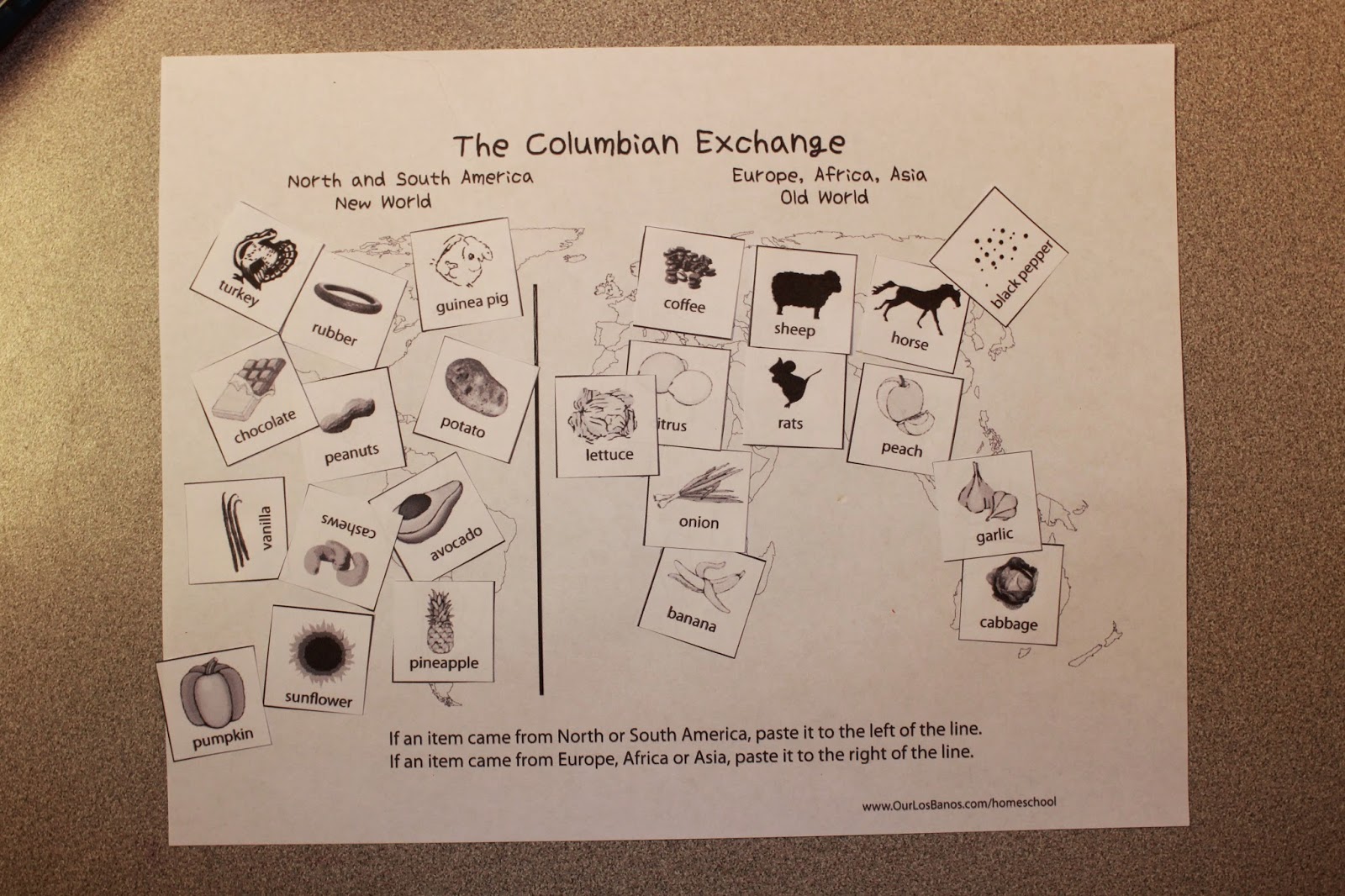

This FREE activity from Guest Hollow requires students to cut out the items (including foods, animals, and other resources) and paste them on either the New World or Old World side of the map.  An answer key is included. 

 
Each of these wonderful picture books tells a version of a Taíno creation myth explaining the origin of the sea.  Click on either of them to view them on Amazon.com.  (We were able to get both from our local library.)  We created a Venn Diagram to compare and contrast the two stories.  (You can find a free Venn Diagram designed for comparing two books right here.)


We studied zemis, sculptural objects the Taíno believed to house spirits, often of ancestors.  Some zemis had full bodies, while others consisted of only a head or mask.  Hunter made this sculpture with Crayola Air Dry Clay.  It's based on an actual zemi at the Walters Art Museum. 


This short video about the decimation of the Taíno peoples was made by Puerto Rican high school students for a senior project.  They did a fantastic job!

Hunter was surprised to learn how many English words come from the Taino language, including:

Barbeque
Canoe
Potato
Manatee
Savannah
Papaya
Cannibal
Cuba
Jamaica
Guava
Hammock
Hurricane
and Iguana

If you want to learn more about the Taino before teaching, here are a couple great resources for adults:

What Became of the Taíno? is a great article on Smithsonian.com

This Wikipedia article is also very informative and links to more great resources.


Blogs and Shops featured in this post:

Tuesday, January 7, 2014

December Catch-Up Post: Seven Summits, Christmas, & More

December was a whirlwind and I'm not gonna lie, blogging was last on my epic to-do list!  No excuses, folks, just trying to catch up . . . 

Here are some of Hunter's December highlights:


This free Christmas-themed alphabetizing activity from Hilary Lewis was a great way to warm up Hunter's mental muscles!  He practiced "ABC order" to the third letter, and recorded the list in the correct order.  There are 40 words included, and you can make the activity more or less challenging based on the words you choose.  We did this twice, with two different lists of words.  It was fun, and great practice!  Get a free copy here!


How cute is this reindeer?!  Poor Hunter hates it when I make him pose with his work, but he did such a great job that I just had to.  There are many ways to complete this writing craftivity, depending on the writing level of the student.  Hunter wrote about what it would be like if he were one of Santa's reindeer, and illustrated it.  Grab the template and printables (23 pages worth) right here.  It's inexpensive and oh so worth it!


I just love this "elf application" that Hunter filled out!  He chose to apply for a job in Santa's bakery.


He listed his huge appetite and his interest in creating new recipes as qualifications.  For a copy of this application for your own little elf, click here.  It's free!


Hunter loved this Math Mystery Picture activity!  It was a great way to practice his multiplication facts. Discovering one of his favorite video game characters dressed as Santa was a fun surprise for him!  For a copy of this freebie from Mr. Peterson, click here!  For the addition and subtraction version (also free), click here.


This simile/metaphor sort is one of a few activities we did to accompany our annual reading of "The Polar Express", by Chris Van Allsburg.  


It's from "Polar Express Centers and Fun For Bigger Kids", a packet of activities for 3rd-5th graders by Fourth and Ten.  I didn't get pictures of everything we did (and the ones I did get were all blurry!), so I can't show you how much fun we had, but I do recommend checking out the product!  You can find it here.


This fun gingerbread house coloring/fractions activity is a freebie from More Time 2 Teach.  Click here to get a copy of Fraction Winter Wonderland!


This is the poster Hunter made to show what he's learned about the Seven Summits.  (This project was inspired by a photo we found on Pinterest, but I haven't been able to track down its origins.)


Each of the colored mountain peaks is to scale, with 1 cm = 1,000 ft.  


He colored the continents to correspond with the paper mountain peaks . . .


 . . . , and drew triangles to show the locations of the mountains.


He worked hard on it, and it looks fantastic up on the wall!


In addition to reading about the mountains and watching documentaries on YouTube and Netflix streaming, we visited each of the peaks on Google Earth.  Viewing the satellite imagery and being able to zoom in from any angle was fascinating for him; he's addicted!  He spent hours looking at mountains and rivers all over the planet, and regularly gets lost in foreign cities thanks to Street View.

And in no particular order, here are the TpT shops mentioned in this post:


Friday, September 13, 2013

Interactive Geography Notebook

In addition to many, many, many other things, Hunter worked on his interactive geography notebook this week.  The results were pretty cool!


This activity was inspired by this post at layers-of-learning.com.  I adapted the idea to meet our needs and the topics we were covering.  We learned about latitude, longitude, the Equator, and the Prime Meridian. 
  •  First, I had Hunter draw a star on the map to mark where we live.  
  • Then he traced the lines of latitude with a fine-point marker (only every other line so the map wouldn't look too cluttered).  
  • Next, he traced the lines of longitude in another color (again, only every other line).  
  • Finally, we cut two lengths of sparkly leftover Christmas ribbon, in gold and silver, to glue over the Equator and Prime Meridian.
Here's a closer look:


To download the free world map from Layers of Learning, click here.

During our next geography class, we discussed how the Equator divides the Earth into two hemispheres, the Northern and Southern.  Likewise, the Prime Meridian and its opposite, the 180th meridian, divide the Earth into Eastern and Western hemispheres.  After studying the hemispheres, we completed this notebook page:


Hunter wrote a simple definition underneath each flap.  For example, under "Northern Hemisphere" he wrote: 'The half of the Earth that lies north of the Equator'.


If you'd like a copy of the flaps, click HERE.
I hope you find them useful!

More resources and links:


Tuesday, September 3, 2013

The First Day!

Well, the first day is officially behind us!  Overall it went very well, though some of the worries I've had all summer turned out to be legitimate.  Colban finished half the work I'd planned for the whole week before lunchtime, and spent the afternoon making messes, noise, and demanding to know when Hunter would be done so he'd have someone to play with.  Hunter's auditory processing problems make it next to impossible for him to filter out background noise, so he had a tough time focusing under these conditions.  I alternated between redirecting Colban to a quiet activity in another room and getting Hunter refocused on his work, only to turn around and find Colby had already gotten bored and returned to make mischief!  We got all of our scheduled work done, but it was still a lot more stressful than it should have been.  Mommy has a headache!

Here are a few of the pics I took of our first day's work:


This is the first page of Hunter's Interactive Geography Notebook.  This is just the example page I made in a spiral notebook; Hunter was self-conscious about his work and didn't want it photographed.  I thought he did a great job!  Hunter's interactive notebooks (for science and geography) are bigger and much nicer than my example books.  We used these, but a composition notebook or even a spiral will work. 


This is a really fun "silent e" sort that I chose for an easy review activity.  It's one of many AWESOME activities included in Puppy Love Common Core Literacy Centers and Printables.  This packet has been worth every dime I spent on it and then some!  (I do occasionally re-size pdf's before printing to save ink; some of these pieces may be smaller than originally intended!)


This is a page from our handwriting practice packet.  (Oh man, that handwriting.  It is an enormous frustration for both of us.)  Check out "Writing Through the Verses" here.  


Colby did several pages of kinder math in this workbook.  I've used the Math Made Easy series with Hunter for three years now, and we love it.  The progress charts (gold star stickers included!) are one of the best things; for each page completed, the child gets to add a star to the chart.  Colban added THREE today!  Whoop whoop!


This great little counting puzzle is from the very cool, very FREE Batman-themed preschool pack from 1+1+1=1.  Colby was thrilled with it.

This is just a small fraction of what we accomplished today.  I'll try to cover what we're doing in math, science, history, reading, and grammar later in the week!  I didn't get pics of any of Colban's alphabet activities, either, but the ones we used today and many more (all free downloads) can be found on my Alphabet Pinterest board.

Ready to do it all over again tomorrow!  Hopefully I can start working out some of the kinks!

TpT products featured in this blog post are from the following shops:


Tuesday, January 15, 2013

Australian Aborigines

In Hunter's history book (The Story of the World: History for the Classical Child: The Middle Ages) there's a chapter on the Aborigines of Australia.  It's a lot harder to find teaching materials on the Aborigines as compared to, say, the Vikings, but we found some interesting books and projects.  Here are a few things we used to get a more in-depth look at the Aborigines:


Sun Mother Wakes the World: An Australian Creation Story by Diane Wolkstein is a beautiful introduction to Aboriginal beliefs about nature and how the world and all the creatures in it came to be.  There's even an explanation for the many unique animals native to Australia, such as the platypus and kangaroo.  This book is a great jumping-off point to talk to children about more complex Aboriginal beliefs such as the Dreamtime, the continual process of creation in which art and "walkabouts" play a part.  (Parents who want to learn more about Aboriginal spirituality and myth before teaching, try this site, or this one).


Ready to Dream, by Donna Jo Napoli.  This easy picture book tells the story of a young girl named Ally who travels to Australia.  Ally wants to capture her impressions of the Outback in her artwork, but she keeps "messing up" her creations.  When Ally meets an Aboriginal artist named Pauline, she learns to rejoice in each mishap and see how it adds to her art.  Children will learn something of the attitude of Aborigines toward nature and art (for which their culture is famous).  The beautiful illustrations of Bronwyn Bancroft, an Aboriginal artist and children's book illustrator, are an education in and of themselves.

For an art project, we chose Aboriginal dot painting:


We used spouncers for the dots, but q-tips would probably work even better.  We looked at examples of Aboriginal art online, and my son was inspired by the flyer from an Aboriginal art sale! (See it here).  I pretty much just provided tempera paints, brushes and spouncers, and a piece of poster board (he chose black), and got out of the way.

He had a lot of fun, and was very proud of his creation. As soon as it was dry, he had me hang it up on his bedroom wall.  Here are some great sites to get tips and instructions on Aboriginal dot painting for children, as well as other Aboriginal crafts and activities:


For more ideas on studying Aborigines and Australia, including free printable Aboriginal art coloring pages, try our "Australia for Kids" Pinterest board here.

A few good websites for viewing Aboriginal art online are:

Australian Aborigines are the oldest continuous culture on the planet; we hope you have as much fun learning about them as we did!