Showing posts with label teacher resources. Show all posts

Monday, March 30, 2015

Eat Like A Bear! (Freebies!)

It's Bear Week here at HHH!  Colby has had so much fun studying bears from around the world, and especially eating lots of "bear food"!

Inspired by First Grade Garden's fabulous bear chart, we focused on four types of bears this week: black bears, grizzly bears, polar bears, and panda bears.  My original intent was to copy her chart, but all of my large chart paper was lost in our recent classroom flood.  Instead, I adapted it for use with our large hanging pocket chart:


Please excuse the messy photo (and my husband's work boots at the bottom)!  Because of the flood, we've been unable to use the classroom and had to hang our chart in the living room on the stair railings.


You can write the students' answers on index cards or anything similar, but if you'd like the blank cards we used, you can download them here.

I also created a set of worksheets to go with it.  There is one for each type of bear, and they look like this:


The big, blank box at the top is space for the student to draw a picture of the bear in its habitat.  Then there is space for the child to choose three interesting facts, write them, and illustrate them.


On Monday, we started off with a great video from one of our favorite YouTube channels, Animal Atlas:


Then we read Eat Like a Bear by April Pulley Sayre, and illustrated by Steve Jenkins, one of our favorites!


What a great book!  It was a fantastic introduction to how a bear's diet changes through the year as different foods become available and others scarce.  It was also a great jumping off point to discuss how a black or brown bear's diet is actually pretty similar to a healthy human diet!  We're both omnivorous, and have lots of foods in common.  We decided to "eat like a bear!" all week and made sure we ate lots of foods that bears like:

Fish
Crabs
Bison/Venison
Leafy greens
Roots & Tubers
Honey
Berries
Apples & other tree fruits
Nuts

We also discussed how, like humans, bears have a natural sweet tooth.  If they have access to lots of honey or other sweet foods, they will eat more than they should.  Not only can this keep them from eating the healthier foods they need to store up quality fat for winter, it can cause cavities in their teeth, just like ours!  Bears with rotting teeth often die when they can no longer tear and chew the foods they need.


Colby had a blast stuffing himself with the bear foods from the list!  We eat venison regularly, but we'd never tried bison before.  We picked up a few pounds of bison burger from the local bison farm (check out Beech Hill Farm & Bison Ranch!) and immediately became huge fans.  It's actually quite similar to the beef from our Highland cattle.

Colby filled out this Venn diagram comparing bear food with the foods he eats:


Some of the foods that ended up in the "bears only" section were grubs, ants, etc.  We don't eat insects (at least, not on purpose!), but we discussed the fact that lots of people around the world do eat grubs and bugs regularly and though it seems gross to our family, they are actually nutritious foods for both bears and humans.

On Tuesday we read American Black Bears

After the book, we filled out the cards for the "black bear" column of our chart.  Then Colby completed the worksheet, choosing three facts about black bears to write down and illustrate.


The next day, we read Grizzly Bears by Gail Gibbons:


We filled out the "grizzly bears" column of our chart, and Colby completed his "Grizzly Bears" worksheet (finished product shown above).


On Thursday, we read Polar Bears by Gail Gibbons:


Then the chart, and the worksheet of course! ;)


And finally, Giant Pandas by Gail Gibbons:


Our chart was complete and looking fantastic, and all four worksheets are done!  We're going to make a cover for them and staple them into a book.

I hope our freebies can help you in your own bear unit!

For more great freebies and DIY homeschool ideas, check us out on Pinterest!
174 Boards and counting!

Thursday, November 6, 2014

Freebies! Buttons, Pete the Cat, Math & Literacy

Over the summer, a friend of mine posted pictures of her son playing with his grandmother's jar of old buttons on Facebook.  My younger son can spend hours sorting and playing with beads, jewels, and other small manipulatives; I knew he'd love to paw through a pile of vintage buttons!  I called my mother, who had kept a box that belonged to her grandmother, and she generously went to dig it out of the attic for us.  After noticing this book online,


I decided to incorporate the buttons into our schoolwork.  We started by reading The Button Box, by Margaret S. Reid.  It's a cute story about a boy going through his grandmother's button box, sorting the buttons and imagining who they might have belonged to.  Colby loved it.


He was thrilled when I put this button box in front of him!
I gave him plenty of time to just enjoy it, and then I asked him to choose one particular button that he really liked.  He selected a matching pair of shiny gold ones, and I gave him this worksheet:


He drew a picture of the button in the center, and then came up with five adjectives to describe it.


I asked him to imagine who might have worn the buttons, and he thought they probably came from some sort of military uniform.  He drew a picture of a soldier wearing the button, and then wrote about it.  
(There are several versions for different ages and writing abilities, and each version comes in color or black-and-white.)


Next, I asked him to sort the buttons.  We talked about all the different ways we could sort them: by size, or shape, or what they were made of, or how old they were.  Then he wrote down some of these ideas on this worksheet:


Finally, we completed this pocket chart activity.  Colby matched the button cards with the appropriate numerals and number words.  He loves the way it looks so much that we're leaving it intact until we need the chart again!


Who else loves buttons?  Pete the Cat, of course!  We read  Pete the Cat and His Four Groovy Buttons, by Eric Litwin.   This is such a cute book!


We did some simple descriptive writing, with an illustration of course.  This page is from Team Sugar's Pete the Cat Journal Writing Prompts.  It's such a cute packet of writing pages, and so inexpensive!


This super fun Pete the Cat Subtraction Mat is a fabulous freebie from Learning With Mrs. Parker.  Check out her blog and snag a copy here!


We did some addition with these button ten frames and two d10 dice.


There are two different colored ten-frames for each number 1-10, so they can be used for adding doubles, or more complex addition.  (They're not all shown in the photo).  


We finished up with buttons and continued with Pete the Cat, moving on to Pete the Cat: I Love My White Shoes by Eric Litwin.  This is my favorite Pete book thus far!  No matter what he steps in, Pete keeps his characteristic positive outlook and loves his shoes.


Colby really enjoyed this cause and effect activity by Allison Palm.


It comes with these great pocket chart cards, which we chose to use on the floor,


and this follow-up sheet.  Colby got to choose his own cause-and-effect scenario for Pete and his beloved white shoes.  Pete stepped in purple paint, and ended up with purple shoes!  You can find these activities right here.  (Super inexpensive!)


The next day, we moved on from learning about cause and effect and focused a little more on color words.  This fun freebie from Made For 1st Grade is actually meant to be assembled into a class book, but it works just as well for a single student!  I knew it was coming eventually - poor Pete stepped in dog poop.  Colby chortled the whole time he practiced writing "brown".


We practiced AB, ABC, ABB, and AABB patterns with this awesome free worksheet from The Groovy Teacher.  Colby loves to color so this was perfect for him!

For lots more Pete the Cat freebies and DIY ideas, try this Pinterest board:


Sunday, September 14, 2014

The Little Red Hen - With Freebies!

For the past two weeks we've been reading fables.  We've mostly been sticking with Aesop, but I decided to include The Little Red Hen as well.  I like the moral of this story; though many these days would disagree, I think it's important for kids to understand that those who expect to eat should also expect to work.

 There are dozens of versions of The Little Red Hen out there, but we decided to stick with a classic:


the Little Golden Book version, by Diane Muldrow.


After reading the book and discussing the moral, Colby used sequencing cards in his tabletop pocket chart to show the steps the Little Red Hen takes to grow wheat and bake bread.


For a free copy of these sequencing cards, keep reading!


He also completed this cut-and-paste sequencing sheet to record his work.  (He insisted on coloring the scenes afterward, of course.  My Colby hates a black-and-white page!)

A copy of the cut-and-paste sequencing activity is included in the free download at the end of the post!


Didn't this come out great?!  We found the idea for the handprint chicken here, at ArtsyCraftsyMom.com.  I love a good writing/art project.


The writing prompt we pasted at the bottom asks, "Would you help the Little Red Hen?  Why or why not?"  Colby's response was, "I would help the Little Red Hen because she asked."  It's completely true, too; Colby is a very helpful little nugget, and a request is all it would take!

For a FREE copy of the sequencing cards, cut-and-paste sequencing activity, and writing prompt, click here!

For my older son Hunter, we skipped the sequencing activities and went straight to the meat of the lesson: discussing the moral in depth.  After our conversation, I gave Hunter this worksheet:


It's a fabulous freebie from Kelly's Classroom Online!  
Hunter wrote about some of his insights and opinions regarding the story.  It's a great activity to extend any lesson on fables; scoot on over to Kelly's Classroom and grab a copy!

We hope some of this will be helpful!
You can find many more activities and ideas to use with The Little Red Hen on our Pinterest board:


Sunday, August 31, 2014

Interactive Science Notebook - Physics Freebies, Part 2

Here we go, more physics for your Interactive Science Notebook!  
(If you missed Physics Freebies Part 1, you can find it here.)


This page has a shutterfold on Potential and Kinetic Energy, and a cutout that says "Energy cannot be created or destroyed, but it can change form".


The shutterfold comes with definitions that fit on the insides of the flaps, and examples of potential and kinetic energy to sort and paste underneath.


Our physics curriculum includes calculating an object's gravitational potential energy in foot pounds, which is simple enough for even younger kids.


This flapbook covers the definitions of "pound", "foot", and "foot-pound", which can get a little confusing!  Definitions to cut and paste under the flaps are included.


This is just a simple problem to demonstrate understanding of calculating GPE.


On this page, Hunter cut out and pasted the cannon and cannon balls (and drew some cute background stuff, like grass and the sun) to show how kinetic energy is gradually transferred to potential energy and back again.  The cannonball has maximum kinetic energy as it is first fired, and just before it hits the ground.  It has maximum potential energy at the top of the arc.

(Two sizes are included in the download.)


The vocabulary words included in this flapbook are: motion, inertia, mass, friction, momentum, and speed.  The definitions included are from our primary text, but if they don't suit you, you can always have your student write underneath the flaps rather than gluing the definitions provided.


This page is one of my favorites; it covers the contributions of Aristotle, Galileo, and Newton to the study of motion, and there's also a staggered flapbook on Newton's Laws.


For this flapbook, the student will need to match each theory or contribution to the correct scientist and paste it beneath the appropriate flap.  Of course, your child can always simply take notes beneath the flaps instead!

(The download includes two options:  to print on one piece of paper, or to use two different colors as shown above.)


This flapbook on Newton's Laws of Motion comes with the Laws and explanations to be pasted on the corresponding flaps.  It also has frames that can be pasted on the undersides of the flaps, for the student to include illustrations of each law.  (I recommend doing the illustrations before you cut out the frames and paste them.  It's just easier.)  The download is designed so that the laws and frames can be printed on white paper, and the flaps can be printed on two different colors that will alternate when the books are put together (as shown).


For loads more freebies and ideas for your Interactive Science Notebook, try our Pinterest Board:


For more physics freebies and activities for kids, check out this board:


There are a lot more freebies on the way this year, in many different subjects.  Don't miss anything!  Consider following us on Facebook or Bloglovin.


Sunday, June 29, 2014

Learning About the Taíno Peoples, and Christopher Columbus

*PLEASE BE AWARE that the Taino people did not wear clothing, and though they are usually shown clothed in books and videos, some artwork online or in documentaries may depict them in various stages of nudity.  I encourage parents and teachers to choose resources ahead of time and preview all documentaries or books, even those recommended here, to make sure you find them appropriate for your children.

In addition to studying the life and voyages of Christopher Columbus, we decided to devote equal time to learning about the indigenous peoples he first encountered.  I wanted Hunter to understand that while Columbus is a celebrated historical figure who certainly changed the world, these changes resulted in tragedy for the inhabitants of the lands he "discovered".


We read many books about Christopher Columbus in addition to our main history text, but these are the two we found the most helpful.  Click on either of the pictures to check them out!


Here's the Interactive 3D Map of Columbus' first voyage that Hunter colored and assembled.  Looks great, doesn't it?  He worked so hard.


Some of the pieces are glued down, but the ships move along the track between Spain and the Caribbean.


We got the map from this book, and look forward to making more!  Click on the picture to find out more about the book; it's a great addition to any homeschool.


He also completed this fabulous flip-flap book from Simply Skilled in Second.  (The finished product can include one of Columbus' ships!  Follow the link to see her examples.)


Each flap has maps, writing prompts, questions, or space to draw so the student can really show what they've learned.


We use these flip-flap books a lot, for history, science, and language arts.  She has a fantastic collection and it's growing all the time!


Hunter loves documentaries, and we were happy to find this one by National Geographic on YouTube.  The title is a little misleading; it's really about the impact of European settlement on the North and Central American civilizations.  It's a good jumping off point for discussion about the positive and negative aspects of the Columbian exchange, and whether any of the negatives could have been avoided. 


This story by Jane Yolen is told from the point of view of a young Taíno boy who is suspicious of the strangers that have suddenly appeared in his land.  He tries to warn the adults of his village that the newcomers seem more interested in gold than friendship, but no one listens.


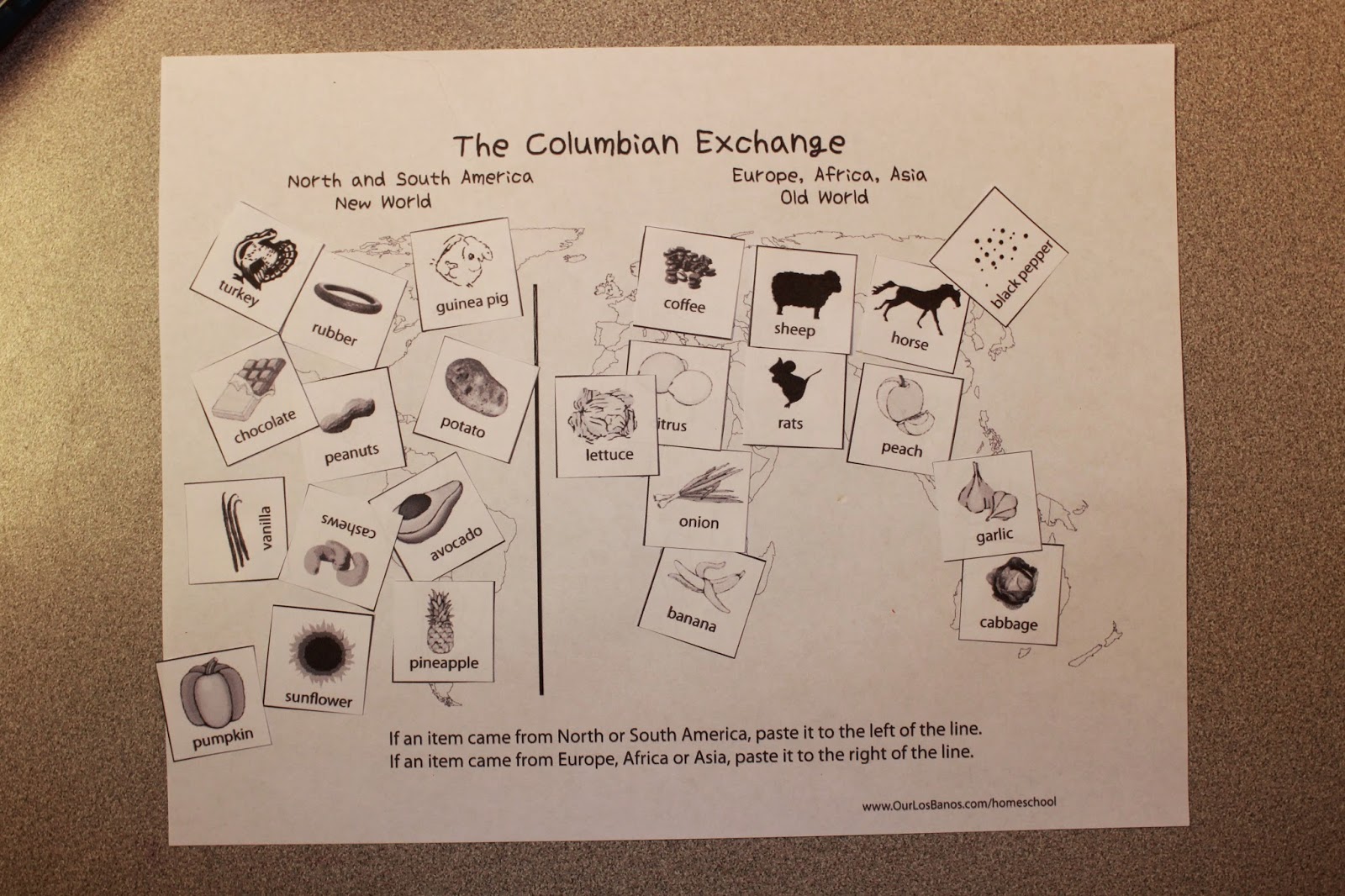
This FREE activity from Guest Hollow requires students to cut out the items (including foods, animals, and other resources) and paste them on either the New World or Old World side of the map.  An answer key is included. 

 
Each of these wonderful picture books tells a version of a Taíno creation myth explaining the origin of the sea.  Click on either of them to view them on Amazon.com.  (We were able to get both from our local library.)  We created a Venn Diagram to compare and contrast the two stories.  (You can find a free Venn Diagram designed for comparing two books right here.)


We studied zemis, sculptural objects the Taíno believed to house spirits, often of ancestors.  Some zemis had full bodies, while others consisted of only a head or mask.  Hunter made this sculpture with Crayola Air Dry Clay.  It's based on an actual zemi at the Walters Art Museum. 


This short video about the decimation of the Taíno peoples was made by Puerto Rican high school students for a senior project.  They did a fantastic job!

Hunter was surprised to learn how many English words come from the Taino language, including:

Barbeque
Canoe
Potato
Manatee
Savannah
Papaya
Cannibal
Cuba
Jamaica
Guava
Hammock
Hurricane
and Iguana

If you want to learn more about the Taino before teaching, here are a couple great resources for adults:

What Became of the Taíno? is a great article on Smithsonian.com

This Wikipedia article is also very informative and links to more great resources.


Blogs and Shops featured in this post: